
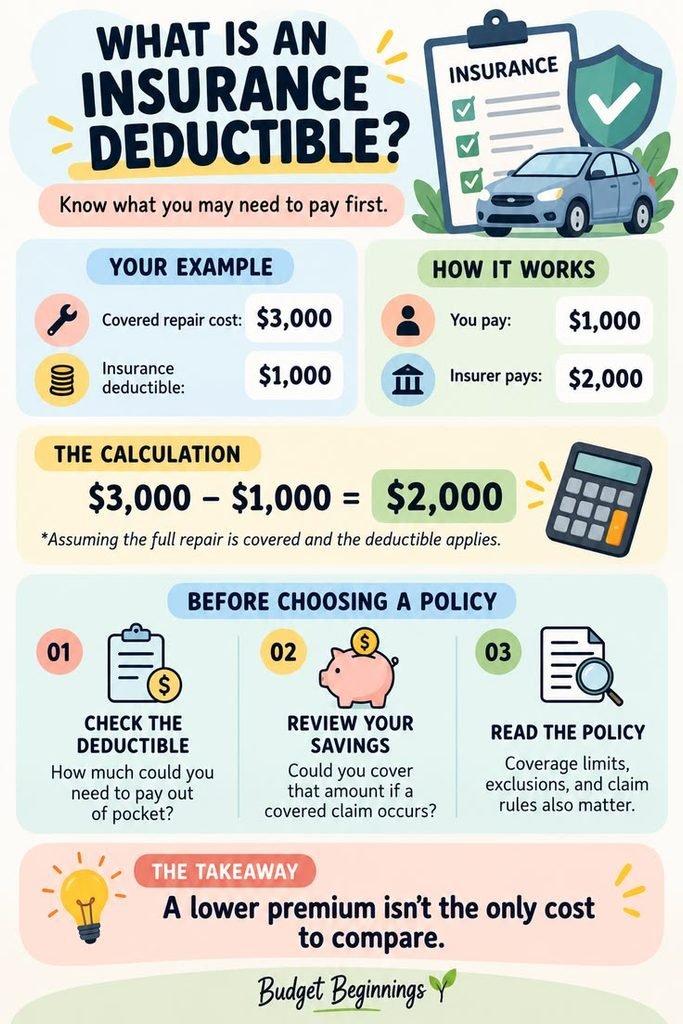
Understanding insurance can sometimes feel confusing, especially when you come across terms such as premiums, coverage limits, copayments, and deductibles. These terms are important because they determine how much you pay for insurance and what happens when you need to make a claim. One of the most important concepts to understand before purchasing an insurance policy is the deductible.
So, what does an insurance deductible mean? An insurance deductible is the amount of money you must pay toward a covered loss or expense before your insurance company pays its share, according to the terms of your policy. Deductibles are commonly found in car insurance, home insurance, health insurance, and other types of coverage.
Understanding how deductibles work can help you compare insurance policies, manage unexpected expenses, and choose coverage that fits your financial situation.
What Is an Insurance Deductible?
An insurance deductible is the portion of an eligible claim that you are responsible for paying yourself.
For example, imagine that you have car insurance with a $500 deductible. If your vehicle suffers $3,000 in covered damage after an accident, you would generally pay the first $500, while your insurance company would pay the remaining $2,500, assuming the damage is covered and no other limits or conditions apply.
The deductible helps determine how the cost of a covered loss is shared between you and your insurer.
Not every insurance policy uses deductibles in the same way. Some policies have a deductible for each claim, while others may use an annual deductible or apply different deductibles to different types of coverage. Your policy documents explain when and how your deductible applies.
How Does an Insurance Deductible Work?
The way a deductible works depends on your insurance policy, but the basic principle is straightforward.
First, you purchase an insurance policy and agree to pay the required premiums. If a covered event occurs, you report the incident and submit a claim to your insurer.
The insurance company then evaluates the claim to determine whether the loss is covered and how much it will pay.
If your deductible applies, you are responsible for that amount before the insurer pays the covered portion of the claim.
Consider this example:
Suppose your home insurance policy has a $1,000 deductible, and a covered incident causes $8,000 in damage.
Here is how the payment would generally work:
- Total covered damage: $8,000.
- Your deductible: $1,000.
- Amount paid by the insurance company: $7,000.
In this situation, you pay $1,000 toward the loss, and the insurer pays the remaining $7,000.
However, this calculation assumes that the entire amount is covered, the claim is approved, and the policy’s coverage limits have not been exceeded. Other policy provisions can affect the final payment.
What Are the Different Types of Insurance Deductibles?
Deductibles vary depending on the type of insurance you purchase. Understanding these differences can help you determine how much you may need to pay when making a claim.
1. Car Insurance Deductibles
Car insurance deductibles commonly apply to certain types of coverage, such as collision and comprehensive insurance.
A collision deductible generally applies when covered damage occurs to your vehicle in a collision. Comprehensive coverage may apply to covered events such as theft, vandalism, or certain weather-related damage, depending on your policy.
For example, if your collision deductible is $750 and your vehicle sustains $4,000 in covered damage, you would generally pay $750 while your insurer covers the remaining $3,250.
However, deductibles do not apply identically to every type of motor insurance. For instance, liability coverage may operate differently, and the rules depend on the policy and jurisdiction.
2. Health Insurance Deductibles
A health insurance deductible is the amount you must pay for eligible healthcare expenses before your plan begins paying for services subject to that deductible.
For example, imagine that your health insurance plan has an annual deductible of $2,000.
If you receive eligible medical services that cost $1,200, you may need to pay the full $1,200 toward your deductible.
If you later receive another $1,500 in eligible services, you would pay the remaining $800 needed to meet the deductible. Your insurer may then begin sharing the costs of covered services according to the policy.
Some services may be covered before you meet your deductible. Preventive care, office visits, prescription medicines, and other benefits may follow different rules depending on your plan.
Health insurance policies may also include copayments, coinsurance, and annual out-of-pocket maximums. These are separate concepts that affect how much you pay for healthcare.
3. Home Insurance Deductibles
Home insurance deductibles apply when you make certain claims involving covered damage to your property or belongings.
For example, suppose a covered incident causes $12,000 in damage to your home, and your policy has a $1,500 deductible.
If the entire loss is covered, the insurer would generally pay $10,500, while you would be responsible for $1,500.
Some home insurance policies have separate deductibles for specific risks, such as windstorms or other covered events. Certain policies may use percentage-based deductibles rather than fixed dollar amounts.
For this reason, homeowners should review their policy carefully to understand how much they may have to pay following different types of damage.
4. Travel Insurance Deductibles
Some travel insurance policies include deductibles for particular benefits, such as medical expenses incurred during a trip or damage to covered belongings.
For example, if your travel insurance policy has a $100 deductible for an eligible medical claim of $700, the insurer might pay $600, assuming the claim meets all coverage requirements.
Other travel insurance policies may have no deductible for certain benefits.
Before travelling, review the policy’s coverage limits, exclusions, deductibles, and claim requirements so you understand what financial responsibility you may have if something goes wrong.
What Is the Difference Between a Deductible and a Premium?
A deductible and a premium are two different insurance costs.
A premium is the amount you pay to maintain your insurance coverage. Depending on the policy, you may pay it monthly, quarterly, or annually.
A deductible is the amount you may have to pay toward a covered claim when an insured loss occurs.
For example, suppose you pay $100 per month for car insurance and have a $500 deductible.
Your annual premium would be $1,200. If you later make an eligible claim with a $2,000 covered loss, you would generally pay the $500 deductible, and the insurer would pay the remaining $1,500.
You pay premiums to maintain coverage whether or not you make a claim. A deductible generally becomes relevant when a covered claim occurs.
Understanding this distinction helps you estimate both your regular insurance costs and your potential expenses following a loss.
Is a Higher Insurance Deductible Better?
A higher deductible is not necessarily better or worse. The right choice depends on your budget, the type of insurance you need, and how much financial risk you can comfortably manage.
Insurance companies sometimes offer lower premiums for policies with higher deductibles because policyholders agree to pay more toward certain claims.
For example, consider two hypothetical car insurance options:
Policy A
- Annual premium: $1,400.
- Deductible: $250.
Policy B
- Annual premium: $1,100.
- Deductible: $1,000.
Policy B saves you $300 annually in premiums. However, if you make a covered claim, you may have to pay $750 more toward the loss than you would under Policy A.
If you rarely make claims, the lower premium may be attractive. However, if paying a $1,000 deductible would create financial difficulties, the cheaper policy may not be the most suitable choice.
Before selecting a higher deductible, consider whether you have enough savings to cover it when needed.
How Can You Choose the Right Insurance Deductible?
Choosing an appropriate deductible involves balancing your regular insurance costs against your potential expenses.
Here are several factors to consider.
1. Evaluate your emergency savings. Choose a deductible you could realistically afford if an unexpected loss occurred. Avoid selecting an amount that would force you into debt.
2. Compare premiums. Request quotations with different deductible amounts to see how much you could save. A higher deductible may not always produce enough savings to justify the additional financial risk.
3. Understand your coverage. Check which events the deductible applies to and whether different deductibles exist for different types of claims.
4. Consider your circumstances. Your financial responsibilities, property value, driving habits, and healthcare needs may influence which deductible is appropriate.
5. Read the policy documents. Confirm how the deductible is calculated, whether it applies per claim or per year, and what happens when the claim amount is lower than the deductible.
Taking these steps can help you choose a policy that balances affordability and protection.
What Happens If Your Claim Is Less Than Your Deductible?
If the cost of a covered loss is less than your applicable deductible, your insurer generally will not pay anything toward that claim.
For example, suppose your car insurance deductible is $500, but the covered damage to your vehicle costs $350 to repair.
Because the repair cost is lower than the deductible, you would generally pay the entire $350 yourself.
In some situations, paying for a small repair out of pocket may be more practical than submitting a claim. However, you should consider any reporting requirements in your policy and the circumstances of the incident before deciding what to do.
Remember that deductibles, coverage terms, and claim requirements vary between policies and insurers.
Conclusion
An insurance deductible is the amount you are responsible for paying toward a covered loss before your insurer pays its share, subject to your policy’s terms and conditions.
Deductibles can affect your overall insurance costs, your claim payments, and the amount of money you need to keep available for emergencies.
A higher deductible may reduce your premium, but it can also increase the amount you must pay when making a claim. A lower deductible may provide greater financial protection at the time of a covered loss, although the premium may be higher.
Before choosing an insurance policy, compare the premium, deductible, coverage limits, and exclusions. Most importantly, select a deductible you can reasonably afford.
Understanding how insurance deductibles work can help you make informed decisions, avoid unexpected expenses, and choose coverage that suits your financial needs.