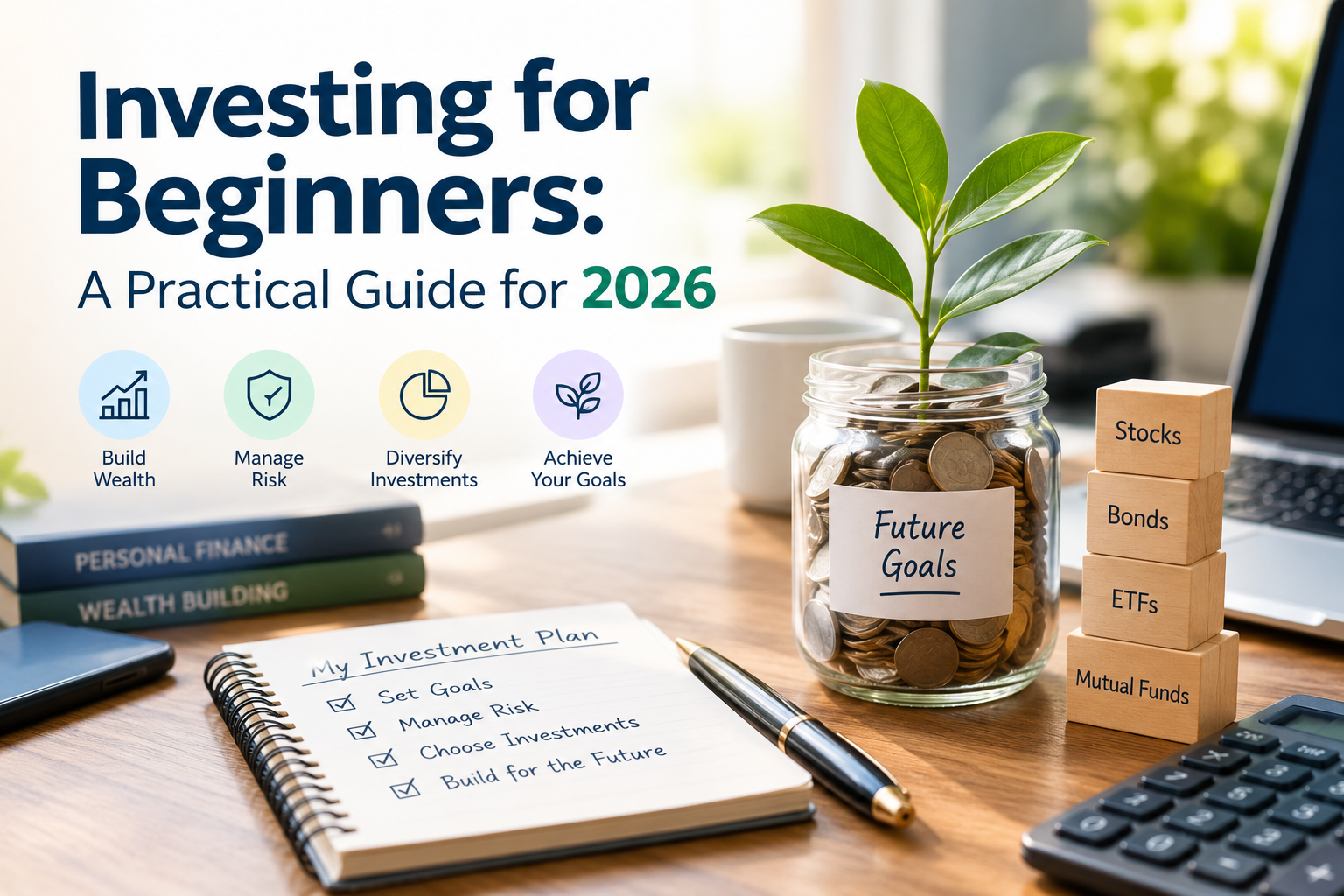
Introduction
Investing can be a practical way to work toward long-term financial goals. Whether you want to prepare for retirement, build wealth, or save for a major purchase, understanding how investments work can help you make better financial decisions. You do not need to be wealthy or have years of experience to get started. You need a clear plan, realistic expectations, and a willingness to learn.
This guide to Investing for Beginners explains the main investment options, how to get started, and how to manage common risks. It also covers fees, diversification, and the importance of choosing investments that fit your financial situation. Although markets can create opportunities for growth, returns are never guaranteed, and you may lose money. The goal is to build knowledge and develop a sensible approach rather than chase quick profits.

What Is Investing and How Does It Work?
Investing means putting money into assets that may increase in value or generate income over time. Common examples include stocks, bonds, mutual funds, exchange-traded funds (ETFs) and real estate. Each option has different costs, risks, and potential returns. For example, when you buy a stock, you purchase a small ownership interest in a company. If the company performs well, its share price may rise and it may pay dividends. However, if the business struggles or market conditions deteriorate, the share price can fall.
Bonds work differently because they generally involve lending money to a government or company in exchange for interest and repayment under agreed terms. However, bonds also carry risks, including default risk and changes in market value. For Investing for Beginners, the main lesson is simple: understand what you are buying, how it might generate a return, and what could cause you to lose money before investing.
How to Start Investing for Beginners in 2026
Starting with a plan can make investing easier to understand and manage. Instead of purchasing assets because they are popular online, follow a process that connects your investments to your financial goals.
Set Clear Financial Goals
First, decide why you want to invest. Your goal might be retirement, a future home purchase, education, or long-term wealth building. Consider how much money you may need and when you will need it.
Your time frame matters. Money needed in the next year or two generally should not depend on investments that could lose significant value just before you need to withdraw it. Longer-term goals may allow you to consider a broader range of investments, depending on your risk tolerance.
Review Your Financial Situation
Before investing, review your income, expenses, existing debts, and savings. Try to establish an emergency fund that can cover unexpected expenses without forcing you to sell investments at an inconvenient time. High-interest debt also deserves attention. If your credit card charges a high interest rate, paying it down may provide a more certain financial benefit than pursuing uncertain investment returns.
A useful Investing for Beginners strategy is to start with an affordable amount that does not interfere with essential bills, debt payments, or short-term needs.
Choose a Regulated Investment Provider
You may need a brokerage account or another suitable investment account to purchase financial assets. Check whether the provider is authorised by the relevant financial regulator in your country. Compare account charges, transaction fees, withdrawal rules, available investments, customer support, and account security. Verify the provider independently rather than relying on advertisements or social media recommendations.
The US Securities and Exchange Commission’s Investor.gov offers educational information on investment products, fraud prevention, and researching investment professionals. Investors elsewhere should also consult their own country’s financial regulator.
Best Investment Options for Beginners
There is no single investment that suits everyone. The right choice depends on your goals, time horizon, local regulations, available products, and willingness to accept losses.
Stocks
Stocks represent ownership in individual companies. They can offer capital growth and sometimes dividend income, but their prices can fluctuate considerably. Buying shares in one company also exposes you to risks specific to that business.
For example, investing all your available money in one technology company could lead to significant losses if the company performs poorly. Beginners should understand the business and the risks before buying individual shares.
Index Funds and ETFs
Index funds aim to track a market index rather than select investments mainly to outperform it. ETFs are investment funds traded on exchanges and some ETFs track indexes while others follow different strategies. A diversified index fund may provide exposure to many companies through one investment. However, not every fund is broadly diversified and market declines can still reduce its value. Check the fund’s holdings, investment objective, fees, and risks before purchasing it.
For any people researching Investing for Beginners, low-cost diversified funds are worth learning about because they can simplify portfolio construction. They are not guaranteed to produce profits.
Bonds and Cash Investments
Bonds may provide interest income, while eligible savings products and certain money market instruments may help preserve short-term funds. Their risks differ. Bonds can lose market value when interest rates change, and issuers may fail to make payments. Cash products may offer lower returns that do not keep pace with inflation.
Consider how much stability and access to money you need before selecting an option.

Understand Risk and Diversification
Every investment involves some level of risk. Share prices can decline, businesses can fail, interest rates can change, and inflation can reduce purchasing power. Some investments can also be difficult to sell quickly at a fair price. Diversification means spreading investments across different assets, companies, industries, or markets. This can reduce the effect of poor performance in one area, although it cannot eliminate losses or guarantee a profit.
Imagine an investor who holds shares in ten companies from the same industry. Although the portfolio contains ten stocks, a major industry downturn could affect many of them at once. A portfolio spread across different sectors and asset classes may reduce this concentration risk.
A sound Investing for Beginners plan considers both risk tolerance and time horizon. Someone investing for retirement decades away may accept more market volatility than someone who needs the money for a home deposit next year.
How Much Money Do You Need to Start?
You do not always need a large amount to begin investing. Some providers allow small purchases or fractional shares, while some funds and accounts have minimum investment requirements. Availability depends on the provider and country.
For example, imagine you can comfortably invest $50 each month. Over one year, you would contribute $600 before any investment gains, losses or fees. Regular contributions can help establish a consistent habit without requiring a large initial payment.
If you are following Investing for Beginners principles, focus on affordability and consistency rather than comparing your starting amount with someone else’s portfolio. Never borrow money simply to invest without understanding the potentially serious consequences.
Understand Fees and the Power of Compounding
Investment costs can include brokerage charges, fund management fees, account fees, currency conversion charges, and taxes. Even small recurring costs can reduce the amount of money that remains invested over time. Review the full fee schedule and investment documents before making a decision.
Compounding occurs when investment earnings remain invested and may generate additional earnings. Over a long period, this can contribute to growth. However, actual returns vary and compounding can work against you when investments lose value.
Consider a hypothetical example: you invest $1,000 and earn a 5% return in the first year. If that return remains invested, your balance would become $1,050 before fees and taxes. A further 5% gain on that balance would bring it to $1,102.50. This illustrates how growth on previous gains can work; it is not a forecast or a guaranteed return. The key Investing for Beginners lesson is to understand how time, contributions, costs, and market performance affect your results.
Common Investing Mistakes to Avoid
New investors can make avoidable mistakes when they act on excitement rather than a plan. One common error is chasing investments because they have recently risen in price. Past performance does not guarantee future results. Another mistake is investing money needed for everyday expenses or emergencies. This may force you to sell during a market downturn. Investors should also avoid putting too much money into a single asset, ignoring fees, or trading frequently without a clear strategy.
Be careful with online investment schemes that promise unusually high returns with little or no risk. Pressure to act immediately, fake testimonials, and requests for suspicious payment methods are warning signs identified by Investor.gov. A responsible Investing for Beginners approach involves independent research, realistic expectations, and patience. Review your plan periodically instead of reacting to every headline.
A Simple Investing Plan for Beginners
Here is a practical example for someone starting from scratch. Suppose you have stable income, manageable debt, and some emergency savings. You decide to set aside $100 each month for a long-term goal. First, confirm that this amount fits your budget. Next, research regulated providers and compare diversified funds, account costs, and local tax rules. Choose an investment mix that matches your risk tolerance and time horizon. Set up regular contributions if suitable, then review your progress at reasonable intervals.
This example is educational, not a recommendation to buy a particular product. Your personal circumstances and local investment rules may call for a different approach. The most useful Investing for Beginners habit is to make informed decisions, keep costs in view, and adjust your plan when your financial goals change.

Frequently Asked Questions
Q1. What is the best investment for beginners?
There is no universal best investment. Diversified index funds, ETFs, bonds, and other regulated investment products may suit different goals. Compare fees, risks, and time horizons before choosing.
Q2. Can I start investing with $100?
Yes, depending on your provider and the products available in your country. Some investments have low minimums, while others require larger amounts. Always check fees and affordability before investing.
Q3. Is investing safe for beginners?
Investing always involves risk, and you can lose some or all of your money. Diversification and research can help manage certain risks, but neither guarantees positive returns.
Q4. How long should I keep my money invested?
Your time horizon depends on your goal. Long-term goals may allow more time to recover from market declines, but no recovery is guaranteed. Money needed soon generally calls for greater attention to stability and access.
Q5. How can beginners avoid investment scams?
Check the provider’s registration with the relevant regulator, research investments independently, and avoid promises of guaranteed high returns. Never send money because someone pressures you to act immediately.
Final Thoughts
Investing can help you work toward long-term financial goals, but success requires patience, planning, and realistic expectations. Start by understanding your finances, setting clear goals, and learning how different investments work before committing your money.
The best approach to Investing for Beginners is not about finding a guaranteed winner or getting rich quickly. It is about choosing suitable investments, managing risk, understanding fees, and building consistent habits. Review your plan as your circumstances change, and seek qualified financial advice when you need help with complex decisions.
With the right knowledge and a thoughtful approach, you can make more informed investment decisions throughout 2026 and beyond.
2 thoughts on “Investing for Beginners: A Practical Guide for 2026”