Introduction
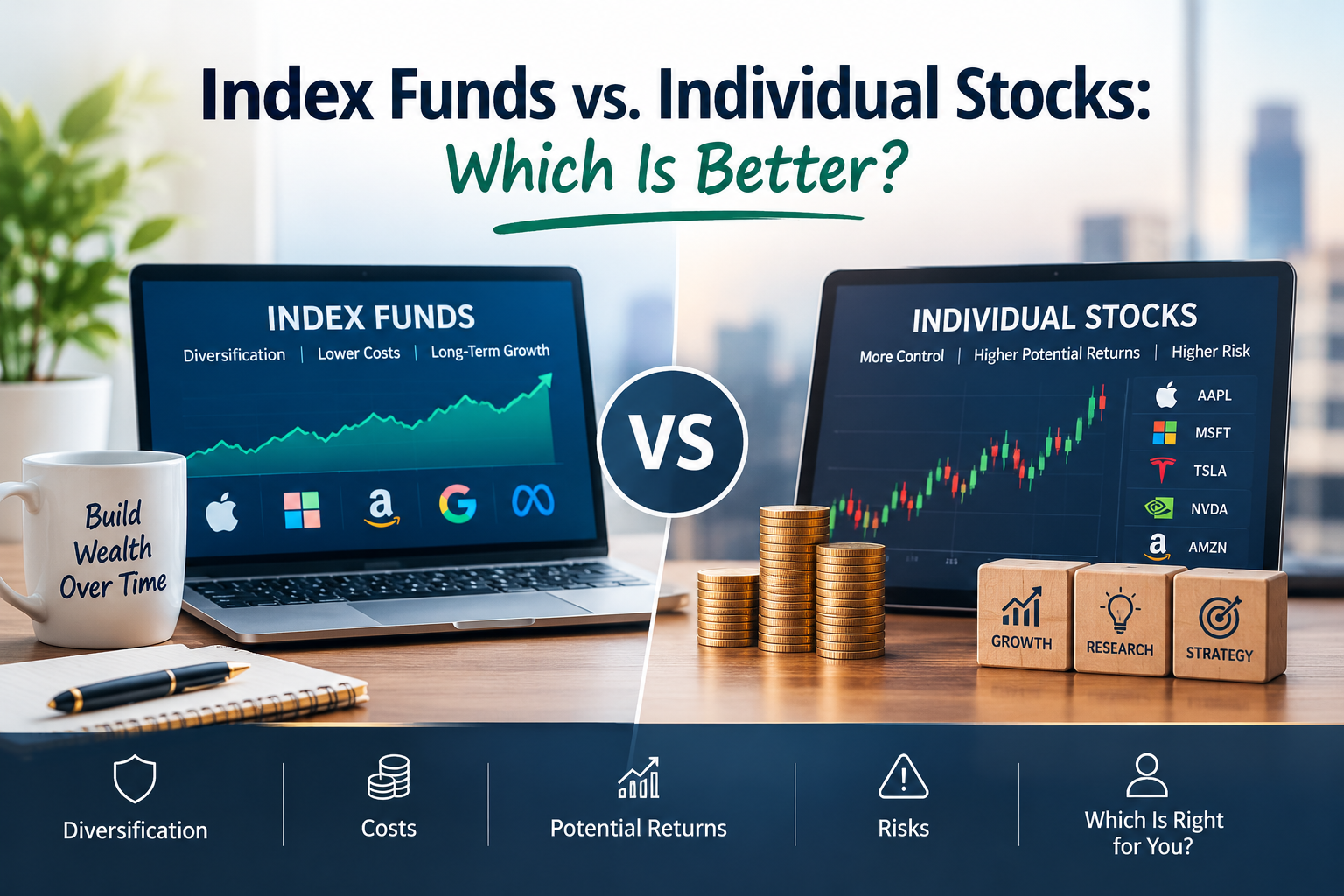
Choosing between index funds and individual stocks is an important decision for anyone who wants to build wealth over time. Both options offer opportunities to participate in the stock market, but they work differently. One spreads your money across multiple investments, while the other lets you invest directly in specific companies.
For beginners, understanding Index Funds and individual stocks can make investing decisions easier. Your choice may depend on your financial goals, available money, risk tolerance, investment knowledge, and the time you can spend researching companies.
There is no single option that works best for everyone. Some investors prefer a simple, diversified approach, while others enjoy researching businesses and selecting shares themselves. Understanding the benefits, costs, and risks of each option can help you make a more informed decision. In this guide, we compare how these investments work, examine their advantages and disadvantages, and share practical examples to help you decide which approach may suit your needs.

What Are Index Funds?
Index Funds are investment funds designed to track the performance of a particular market index. An index measures the performance of a group of investments. Examples include the S&P 500, which tracks large US companies, and broader market indexes that cover different parts of the stock market.
An index fund may hold all the securities in its target index or use a representative sample. Investors purchase shares in the fund rather than buying every underlying company individually. These funds are available as mutual funds and exchange-traded funds (ETFs). For example, an S&P 500 index fund provides exposure to many large US companies through a single investment. This makes it easier to spread money across businesses instead of depending on the performance of just one company.
Many Index Funds follow a passive investment strategy. Rather than trying to select winning stocks, the fund aims to track its chosen benchmark before fees and other costs. However, returns are not guaranteed, and different funds can have different fees, holdings, and tracking results.
What Are Individual Stocks?
Individual stocks represent ownership shares in a particular company. When you buy a company’s stock, you become a shareholder and may benefit if its share price increases. You may also receive dividends if the company declares them. Unlike Index Funds, individual stocks allow you to choose exactly which businesses you want to own. You can research a company’s earnings, financial position, products, competition, leadership, and future plans before investing.
Imagine you believe a technology company will grow because demand for its products is increasing. You could purchase its shares and benefit if the business performs well and the market price rises. However, disappointing earnings, stronger competition, poor management, or wider economic problems could cause the share price to fall.
Individual stock investing offers greater control, but it also places more responsibility on you to evaluate companies and manage risk.
Index Funds vs. Individual Stocks: Key Differences
The main difference is diversification. Index Funds usually provide exposure to several companies through one investment, whereas a single stock ties your investment results to one business.
| Feature | Index Funds | Individual Stocks |
|---|---|---|
| Diversification | Often hold many securities | Depends on how many stocks you own |
| Research | Usually less company-by-company research | Requires company analysis |
| Control | Fund determines holdings based on its index | You select each company |
| Costs | Fund expenses and possible trading costs | Trading costs and possible research expenses |
| Potential returns | Generally follow the chosen index, less costs | Depend on each company’s performance |
| Main risk | Market declines and concentration within the index | Company-specific and market risks |
Not all funds are equally diversified. A fund focused on one industry or a small group of companies may carry significant concentration risk. Always review the fund’s index, holdings, and costs before investing.
Benefits of Index Funds
Diversification Across Companies
One major advantage of Index Funds is the ability to spread your investment across multiple companies. If one business performs poorly, its effect on your overall investment may be limited by the performance of other holdings.
Diversification does not eliminate risk, but it can reduce dependence on a single company. A broad-market fund may be particularly useful for investors who want exposure to a wide range of businesses without researching every stock individually.
Simpler Long-Term Investing
Index Funds can offer a straightforward approach for people who prefer not to monitor individual companies constantly. Investors can choose a suitable fund, review its costs and holdings, and make contributions according to their financial plan.
This approach can reduce the pressure to react to every market headline. However, you should still review your portfolio periodically and confirm that the fund remains appropriate for your goals.
Potentially Lower Costs
Many traditional Index Funds have relatively low management expenses because they follow an index rather than relying on frequent active stock selection. Lower costs can help preserve more of an investment’s returns over time.
Still, fees vary. Compare the expense ratio, brokerage charges, bid-ask spreads where applicable, and any other costs. A low fee does not make a fund automatically suitable or profitable.
Risks and Limitations of Index Funds
Index Funds can lose value when the market or the index they track declines. A fund tracking large companies may perform poorly during a downturn affecting those businesses. Investors can lose some or all of their invested money. Some indexes also concentrate heavily on particular sectors or large companies. Owning several funds does not guarantee diversification if they hold many of the same investments.
Another limitation is that a traditional index fund generally aims to match its benchmark rather than outperform it. If you want to select specific businesses based on your own research, this approach may feel restrictive. Before investing, review the fund’s prospectus, holdings, investment objective, fees, and risks. Consider whether its underlying market and currency exposure fit your financial circumstances.

Benefits of Investing in Individual Stocks
Greater Control Over Your Portfolio
Individual stocks let you choose which companies to own and how much to invest in each one. You can focus on businesses, industries, or regions that you understand well.
This flexibility can be useful if you enjoy analyzing financial statements and following business developments. However, greater control also means you are responsible for making sound decisions and avoiding excessive concentration.
Potential to Outperform the Market
A carefully selected stock may deliver higher returns than a broad market index. For example, an investor who identifies a successful business early may benefit substantially from its growth.
However, finding such companies consistently is difficult. A stock that appears promising may underperform because of changing market conditions, competition, or unexpected business problems. Past performance does not guarantee future results.
Direct Ownership of Selected Businesses
Individual stocks allow you to support your investment decisions with specific research and personal objectives. You can choose companies based on their financial strength, business model, dividend history, or growth potential.
Unlike a broad index fund, a portfolio of individual stocks can be customized to reflect your preferences. The trade-off is that building a well-diversified portfolio may require more research, money and ongoing attention.
Risks of Investing in Individual Stocks
The biggest concern is company-specific risk. If a company loses customers, faces legal problems, or reports weak financial results, its share price may fall sharply. A poorly performing company can cause substantial losses for shareholders.
Individual stock investing can also encourage emotional decisions. Investors sometimes buy after prices rise because they fear missing out or sell during a temporary decline because they feel worried. A research-based strategy can help, but it cannot remove investment risk.
Building a portfolio with multiple companies across different sectors may reduce dependence on one business. However, owning several stocks in the same industry may still leave you exposed to similar risks.
Practical Example: Investing $1,000
Suppose you have $1,000 available for long-term investing. You are comparing a broad index fund with an investment in one individual company. With Index Funds, your money could provide exposure to many companies through one fund, depending on the index it tracks. With an individual stock, your investment depends much more heavily on the performance of the selected business.
Consider a simplified example. If a $1,000 stock investment falls by 30%, it becomes worth $700 before fees and taxes. If a diversified fund falls by 10% over the same period, your $1,000 investment becomes $900. These figures are hypothetical and illustrate possible outcomes, not forecasts.
The fund could also fall more than the individual stock and a successful individual company could outperform the fund. The important difference is that diversification spreads company-specific risk across multiple holdings. Before investing, consider if you have emergency savings, whether you can leave the money invested for an appropriate period, and whether a temporary loss would affect your essential expenses.
How to Choose the Right Investment Strategy
The right approach depends on your goals, experience, and comfort with risk. Rather than choosing based on recent market performance, consider how much time you can commit to investing and how you would respond to losses.
Consider Your Experience
If you are new to investing, Index Funds may offer a simpler starting point because they can provide broad market exposure without requiring you to select individual companies. Nevertheless, you must understand the fund’s investment objective and risks.
Experienced investors who enjoy company research may prefer individual stocks for part of their portfolios. They should still assess valuations, financial statements, competitive advantages, and the possibility of permanent losses.
Review Your Time Horizon
Money needed soon may not be suitable for volatile stock investments. A longer time horizon can give you more opportunity to remain invested through market fluctuations, but it does not guarantee a positive return.
If you are investing for retirement or another distant goal, a diversified portfolio may be worth considering. Your overall allocation should also account for other assets, such as bonds and cash, based on your needs and risk tolerance.
Compare Fees and Taxes
Check the expense ratio and trading costs of any fund you consider. Individual stocks may involve commissions or other transaction costs, depending on your broker and market.
Tax rules also vary by country. Dividends, capital gains, fund distributions, and foreign investments may receive different tax treatment. Review the rules that apply to your location before deciding.
Consider a Combined Approach
You do not necessarily have to choose only one option. Some investors use a diversified index fund as the core of their portfolio and allocate a smaller amount to individual stocks they have researched.
This approach can combine broad exposure with personal choice, but it does not guarantee better performance. The stock portion can increase risk, especially if it becomes too large or overlaps heavily with the fund’s holdings.
Common Mistakes to Avoid
One mistake is assuming that Index Funds cannot lose money. They can decline significantly during market downturns and a fund focused on a narrow sector may be especially volatile. Another mistake is selecting investments based only on recent returns. Strong recent performance does not prove that a fund or company will continue to perform well. Compare the investment strategy, fees, risks, and suitability for your goals.
Avoid investing money you cannot afford to leave invested or potentially lose. Be cautious about social media stock tips, guaranteed-return promises and pressure to make quick decisions. Reliable investment choices require research rather than hype.

Frequently Asked Questions
Q1. Are Index Funds better than individual stocks for beginners?
They can be a practical option because broad-market funds provide exposure to multiple companies and usually require less company-by-company research. However, suitability depends on the fund, your goals and your ability to accept losses.
Q2. Can Index Funds lose money?
Yes. Their value can fall when the underlying index declines. Diversification can reduce dependence on a single company but it cannot prevent market losses.
Q3. Can individual stocks earn higher returns?
Yes. A successful company may outperform the market, but individual stocks can also underperform or lose substantial value. Higher potential returns are not guaranteed.
Q4. How much money do I need to start investing?
The minimum depends on your broker, country and chosen investment. Some funds have low minimum investments, and certain brokers offer fractional shares. Check eligibility, fees and local rules before opening an account.
Q5. Can I invest in both index funds and individual stocks?
Yes. Some investors combine diversified funds with selected stocks. The allocation should reflect their risk tolerance and goals and they should check for overlapping holdings and excessive concentration.
Final Thoughts
Choosing between Index Funds and individual stocks comes down to your investment goals, knowledge, time, and tolerance for risk. Index Funds can provide a relatively simple way to access a group of companies, while individual stocks offer more control and the possibility of outperforming the market.
Neither approach guarantees profits. Before making a decision, compare fees, understand the underlying investments, consider your time horizon, and maintain a sensible level of diversification. For many beginners, starting with a broad, low-cost fund may be easier than trying to identify winning stocks. Investors who prefer researching companies may choose individual stocks, provided they understand the risks. You can also consider a combination of both.
The best investment strategy is one you understand, can afford, and can follow consistently through changing market conditions. Make decisions based on reliable information and your financial circumstances rather than short-term excitement.
1 thought on “Index Funds vs. Individual Stocks: Which Is Better?”